


























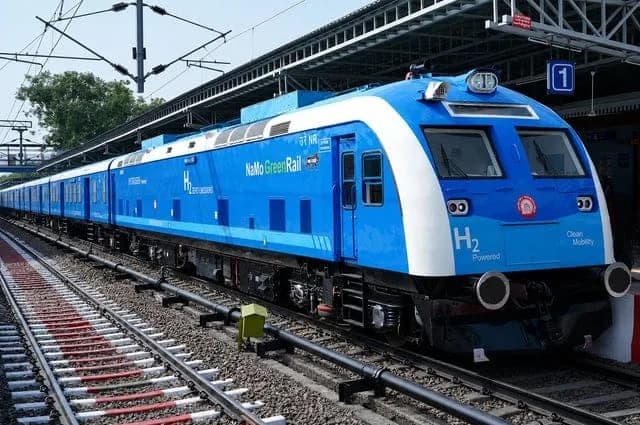
India has taken a significant step towards sustainable transportation with the launch of its first hydrogen-powered passenger train.
Flagged off by Prime Minister Narendra Modi on July 17, the indigenous train will operate on the Jind-Sonipat section of Northern Railway in Haryana, marking India’s entry into the select group of countries using hydrogen-powered passenger rail technology.
The initiative is aimed at promoting cleaner mobility while reducing dependence on fossil fuels.
Affordable ticket prices for passengers
One of the biggest attractions of the new hydrogen train is its low fare.
Ticket prices begin at just Rs 5, while the highest fare on the route is Rs 25 depending on the distance travelled.
Passengers on the inaugural journey also purchased tickets priced at Rs 5, making the service cheaper than even a platform ticket in many cases
Route and operating speed
The hydrogen-powered train runs between Jind Junction and Sonipat in Haryana. Along the route, it stops at stations including Jind City, Pandu Pindara, Lalit Khera Halt, Bhambhewa, Isapur Kheri Halt, Butana Halt, Khandrai Halt, Rabrah Halt, Lath, Mohana and Barwasni Halt before reaching Sonipat.
The train has an approved operational speed of 75 kmph, while its design speed is 110 kmph, according to the official release.


What makes the hydrogen train different?
Unlike conventional diesel trains or electric trains powered through overhead lines, the new train generates electricity onboard using hydrogen fuel cells.
The technology combines hydrogen with oxygen to produce electricity, releasing only water vapour and heat as by-products, making it an environmentally friendly alternative.
The train consists of 10 coaches, including two hydrogen-powered driving power cars and eight trailer coaches. It is equipped with a 1,200 kW hydrogen fuel-cell propulsion system and can accommodate around 2,600 passengers.
Multiple safety features, including hydrogen leak detectors, smoke sensors, flame detectors and overheating protection systems, have also been installed.
Part of India’s green transport push
The project forms part of Indian Railways’ broader effort to adopt greener technologies.
The initiative has also led to the creation of India’s largest railway hydrogen storage and refuelling facility at Jind, capable of storing nearly 3,000 kg of hydrogen. Officials said the facility complies with international safety standards and has undergone independent safety assessments.
With the launch, India joins countries including Germany, China, Japan and the United States in adopting hydrogen-powered rail technology for cleaner transportation.
FAQs
Q. How much does a ticket for India’s first hydrogen train cost?
Ticket prices start at Rs 5 and go up to Rs 25 depending on the travel distance.
Q. Which route does India’s first hydrogen train operate on?
The train runs between Jind Junction and Sonipat in Haryana.
