



























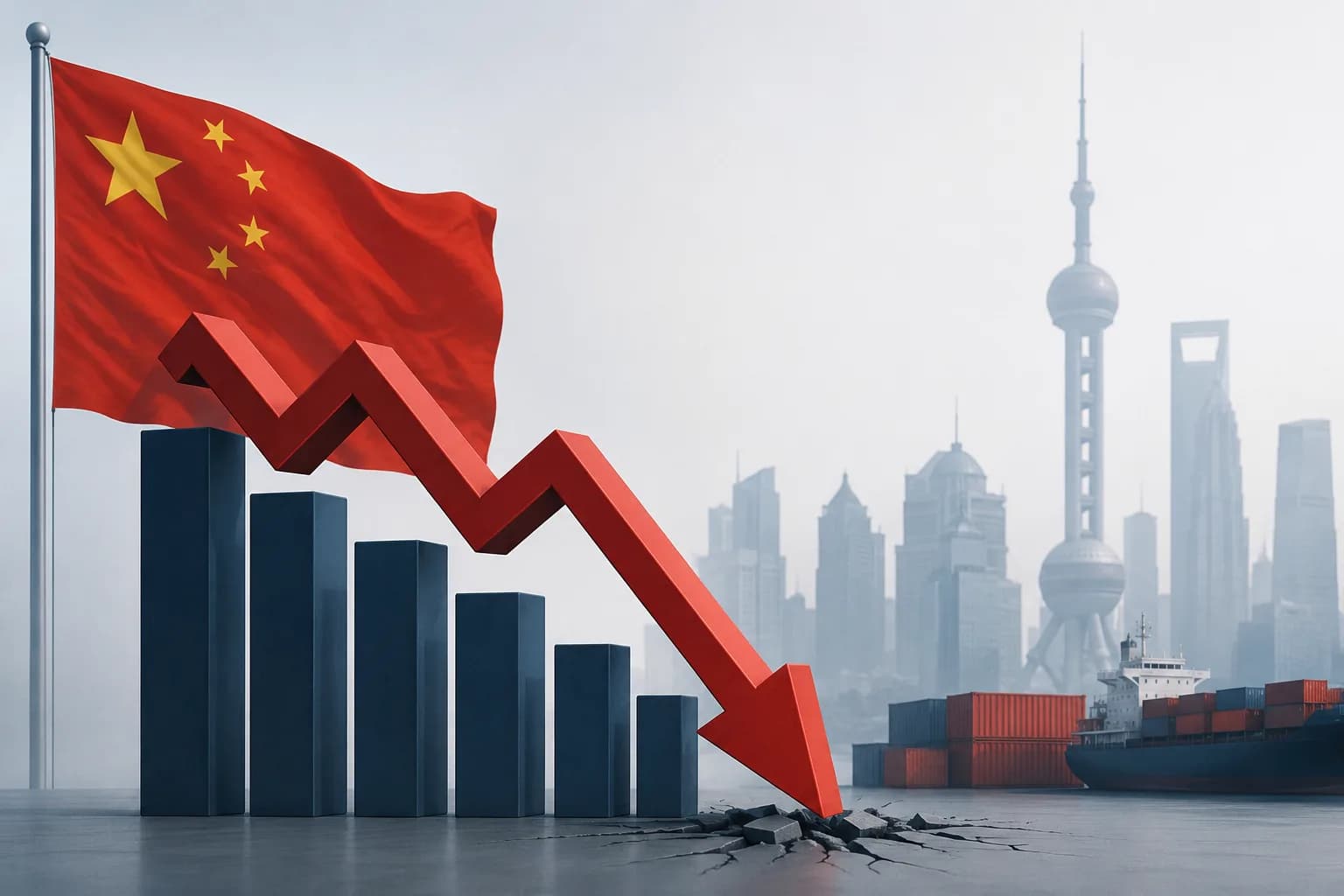
China’s economy grew 4.3% in the April-June quarter, according to official data released on Wednesday, marking its weakest pace since late 2022 and missing analysts’ expectations.
The reading was down from 5.0% in the first quarter and fell below the lower end of Beijing’s full-year target range of 4.5% to 5.0%.
The National Bureau of Statistics said first-half GDP expanded 4.7% year on year, keeping the economy within target for now even as the quarterly slowdown underlined mounting pressure on domestic demand.
Also Read | What is Iran’s Pickaxe Mountain? The underground nuclear site Trump wants to hit
🇨🇳 China's economy grew 4.3% year-on-year in second quarter of 2026, the weakest growth since 2022.
— The Spectator Index (@spectatorindex) July 15, 2026
A chill beneath the dragon’s stride
The slowdown was driven largely by weak household spending and softer investment, even as industrial output and exports remained comparatively resilient.
Retail sales rose just 1.0% in June, while industrial output increased 5.3%, both figures highlighting the gap between factory activity and consumer demand.
Fixed-asset investment fell 5.7% in the first half of the year, and property investment dropped 18.0%, reinforcing the drag from China’s prolonged real-estate downturn.
Economists see the deeper problem not only as slower growth but also as the economy’s uneven composition.
🚨 🇨🇳 CHINA GROWTH SLOWS AS WEAK CONSUMERS OVERSHADOW AI EXPORT BOOM
— Naeem Aslam (@NaeemAslam23) July 15, 2026
China’s economy grew 4.3% year-on-year in Q2 2026, missing forecasts of 4.5% and falling below the government’s 4.5%-5% growth target. Retail sales rose only 1% in June, while property investment dropped 18% as…
A penny saved, but little spent
Officials and analysts pointed to the property slump, sluggish wages, and cautious spending as the main reasons consumers remain subdued.
One small business owner in eastern China, Jane Hou, said her income had roughly halved since the start of the year after sales weakened.
A central bank official said monetary conditions were “relatively loose” and pledged support for domestic demand. Analysts warned the government may stop short of a large stimulus package because of debt concerns.
Several economists expect policymakers to focus more on targeted support for households and consumption than on a broad new wave of infrastructure spending.
🇨🇳 China’s real GDP increased +0.9% QoQ and +4.3% YoY in Q2, down from +1.3% QoQ and +5.0% YoY in Q1, the weakest quarterly growth since Q2 2024, reflecting softer momentum in domestic activity.
— MTS Insights (@MTSInsights) July 15, 2026
For H1 2026, GDP rose +4.7% YoY, with primary industry up +3.7%, secondary industry… pic.twitter.com/XiVKvzyQAh
Overseas orders hold the fort
Exports are still providing a crucial buffer. Trade data showed outbound shipments jumped 27% in June, helped by global demand tied to the AI boom and by frontloading ahead of expected US tariff changes later this year.
But external demand cannot fully solve China’s internal imbalance, especially as trading partners raise concerns about excess supply and global risks remain elevated.
The next major policy signal is expected at the Communist Party’s Politburo meeting later this month. China will be watching for any shift in fiscal or consumption support.
Also Read | Russia’s Sea of Azov shipping route faces mounting pressure after Ukraine’s drone campaign
FAQs
Q1: Why did China’s economy slow to 4.3% in the second quarter of 2026?
China’s GDP growth slowed due to weak consumer spending, falling property investment, and softer domestic demand despite strong exports and industrial output.
Q2: Why does China’s slower economic growth matter globally?
As the world’s second-largest economy, slower growth in China can affect global trade, commodity demand, supply chains, and export-driven economies such as India.
