























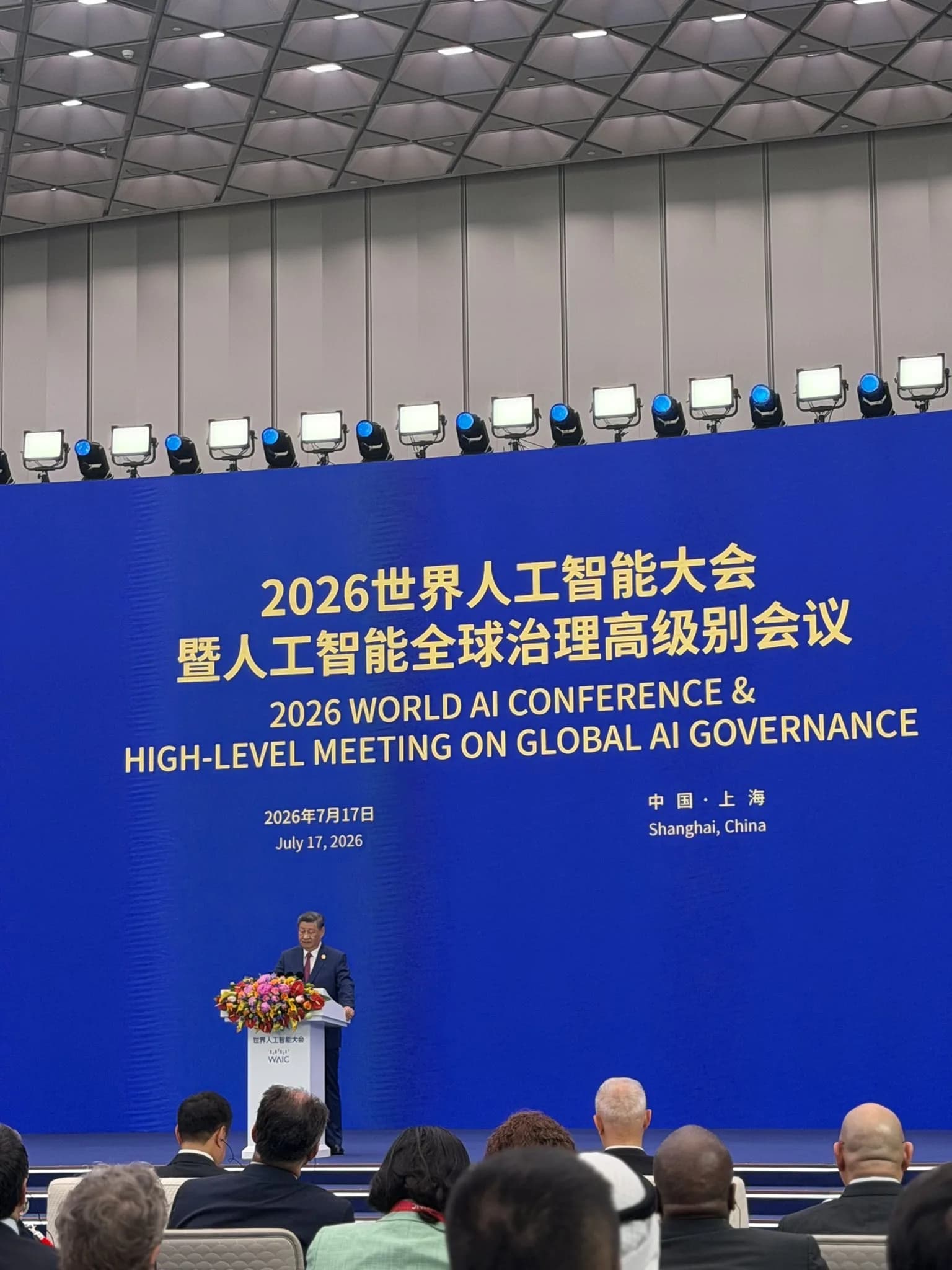
Chinese President Xi Jinping used the opening of the World Artificial Intelligence Conference in Shanghai on Friday to argue that AI should be shaped through international cooperation rather than controlled by any single power.
Beijing stepped up efforts to present itself as a leader in global AI governance. Xi said the technology should not become the preserve of one country, in remarks that also drew a clear line against US influence in the fast-moving sector.
The conference came a day after China helped launch the World Artificial Intelligence Cooperation Organisation, or WAICO, an intergovernmental body based in Shanghai that says it aims to promote international cooperation and global governance in artificial intelligence.
The new body has 29 member countries. The founding members include states from Africa, Asia, Latin America and Europe, underscoring Beijing’s effort to build a broad coalition around its AI agenda.
Also Read | Trump’s veteran-first CDL plan could hit thousands of Indian-origin truck drivers
Xi Jinping AI speech transcript:
— Judd Rosenblatt (@juddrosenblatt) July 17, 2026
Distinguished colleagues and guests, ladies and gentlemen, friends,
70 years ago, a group of young scholars proposed the concept of artificial intelligence for the first time at the Dartmouth workshop in New Hampshire of the United States. In… https://t.co/upaMbrHLE8
A tune for every nation
In his address, Xi urged countries to seize the “historic opportunity” of open-source AI and warned against “new historical injustices” that could emerge if access to the technology remains uneven.
Xi said, “The development of artificial intelligence should not be a solo performance by any single country but rather a symphony of global cooperation.” He also said, “We should together oppose the practice of overstretching the concept of national security in the field of artificial intelligence and of placing one’s own security above that of other countries.”
Those comments fit a broader Chinese message that AI should be treated as a public good. Xi framed China’s open-source models as a global public good and positioned Beijing as an alternative to Washington in setting the rules for the sector.
Key takeaways from President Xi's speech in his first ever appearance at the World AI Conference in Shanghai:
— Vincent Chow (@vince_chow1) July 17, 2026
– Started the speech by referring to his signature maxim, "great changes unseen in a century are unfolding across the world"
– Said that the world has "entered an… pic.twitter.com/j9Gp3BtpUC
More than fine words on parchment
Xi also tied the AI pitch to practical commitments. China will expand AI cooperation with the Association of South-east Asian Nations, the League of Arab States, the African Union, the Community of Latin American and Caribbean States, the Shanghai Cooperation Organisation and the BRICS countries.
He promised 5,000 AI training opportunities for developing countries over the next five years and access for 30 countries to a Chinese-developed AI meteorological tool that can provide early warnings.
The message was aimed especially at the Global South, where Beijing is trying to deepen influence by offering cheaper, open-source tools and training rather than the more closed systems associated with US firms.
Who gets to write AI’s rulebook?
The new alliance and Xi’s speech also landed against the backdrop of intensifying US-China technology rivalry.
Washington has assembled 35 countries behind its AI Opportunity Statement, compared with 29 countries signed up to the China-led WAICO.
Analysts said Beijing is trying to avoid being cast as a rule-taker in a sector increasingly shaped by American companies, export controls and technology partnerships.
The same conference also showcased China’s domestic AI progress, including Moonshot AI’s Kimi K3 model, which the company described as the world’s largest open AI model by parameter count.
For Beijing, the Shanghai gathering was not just a showcase of technical progress. It was a diplomatic message that China wants a seat at the table where AI’s rules are written.
Also Read | Andy Burnham confirmed as Labour chief, Britain’s seventh prime minister in a decade awaits
FAQs
Q1: What is the World Artificial Intelligence Cooperation Organization (WAICO)?
WAICO is a China-backed international organisation launched to promote global cooperation and governance in artificial intelligence.
Q2: Why is Xi Jinping calling for international cooperation on AI?
Xi says AI development should be shared globally and not be dominated by any single country or restricted through geopolitical competition.
