





















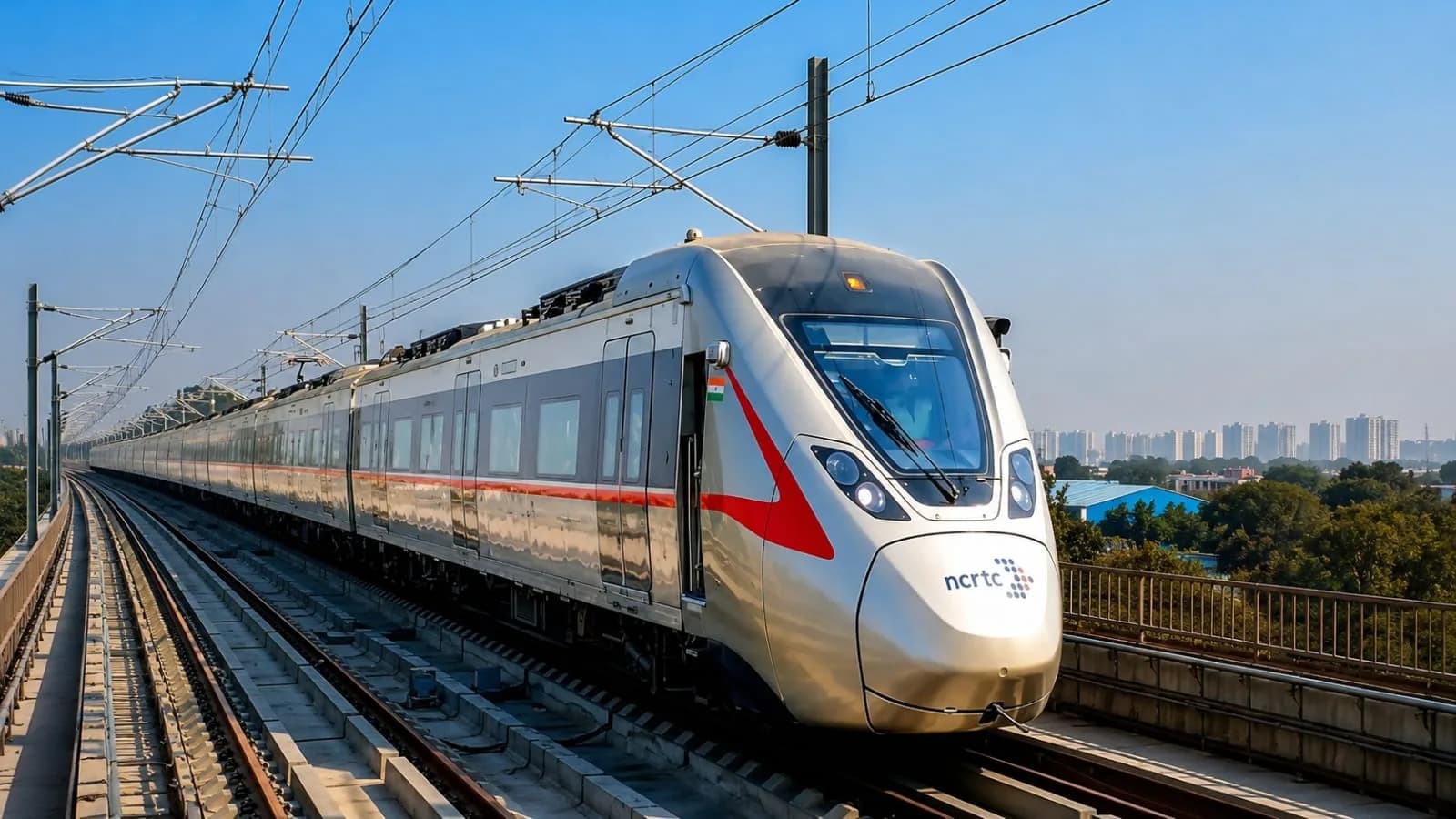
The Namo Bharat train has already transformed how people travel between Delhi, Ghaziabad, and Meerut, and now that same transformation is set to reach right up to the foothills of the Himalayas.
In a big push for better regional connectivity, the Centre has given its in-principle approval to extend the Delhi-Meerut Regional Rapid Transit System (RRTS) beyond Modipuram in Meerut, all the way to Haridwar and Rishikesh. This proposed 150-km stretch will connect two of India’s most important pilgrimage destinations to the country’s fastest regional rail network.
If the project goes ahead as planned, it will do much more than cut travel time. It promises to reshape the economies of western Uttar Pradesh and Uttarakhand, boost tourism, support industries, create new real estate hubs while reducing pressure on one of North India’s busiest highways.
Also Read | Vikram-1 launch makes India third nation with private orbital capability
The proposal is still in the planning stage. A Detailed Project Report (DPR) survey is underway. But the vision is already clear, create a seamless high-speed rail spine connecting Delhi-NCR with the Ganga cities.
How the project took shape
The proposal gained momentum after Uttarakhand Chief Minister Pushkar Singh Dhami repeatedly raised the issue with Prime Minister Narendra Modi and Union Housing and Urban Affairs Minister Manohar Lal Khattar.
Following these discussions, the Centre gave the project in-principle approval.
The Uttar Pradesh and Uttarakhand governments, along with the National Capital Region Transport Corporation (NCRTC), agreed to jointly take the proposal forward.
Surveys underway to finalise the route
Officials are now conducting surveys for the DPR, which will finalise the alignment, station locations, land requirements and engineering details. Uttarakhand has appointed Additional Secretary Reena Joshi as the nodal officer, while NCRTC and Uttar Pradesh have also designated officials to coordinate the exercise.
Also Read | PM Modi explains Vande Mataram note sent on Vikram-1 mission
Only once after the DPR is completed will the final cost and construction timeline become clear.
A rail link connecting industry and pilgrimage
The proposed corridor will begin from Modipuram, the northern end of the operational Delhi-Meerut Namo Bharat line.
From there, the Namo Bharat is expected to pass through Daurala, Khatauli and Muzaffarnagar before reaching Purkazi, near the Uttar Pradesh-Uttarakhand border. The line will then continue through Roorkee and Haridwar, finally terminating near Laxman Jhula in Rishikesh.
Around 72 kilometres of the corridor will lie in Uttar Pradesh, while nearly 78 kilometres will fall within Uttarakhand.
Once linked to the existing Delhi-Meerut RRTS, passengers from Haridwar and Rishikesh would be able to travel directly to Ghaziabad, Anand Vihar and Sarai Kale Khan.
Future interchange stations are also expected to connect this corridor with the upcoming Delhi-Panipat and Ghaziabad-Noida International Airport RRTS routes.
Travel time could be cut almost in half
Today, travelling from Delhi to Rishikesh by road usually takes five to six hours, depending on traffic along NH-58.
Namo Bharat trains are designed to run at speeds of up to 160 kmph. That could bring the journey down to roughly two-and-a-half to three hours.
The impact could be significant. Business travellers could complete same-day trips, and pilgrims would have a faster, more predictable journey. Weekend tourism from Delhi-NCR may also get a major boost, while even daily commuters between western UP and the National Capital Region could benefit.
How much will it cost?
The government hasn’t announced an estimated cost yet, as it depends on the DPR findings.
For comparison, the 82.15-km Delhi-Ghaziabad-Meerut RRTS corridor cost around ₹ 30,274 crore. That project was jointly financed by the Centre, state governments, and multilateral lenders including the Asian Development Bank, Asian Infrastructure Investment Bank and New Development Bank.
Also Read | Why India wants to renegotiate the Indus Waters Treaty with Pakistan
Since the proposed extension is nearly twice as long, experts expect the investment to run into tens of thousands of crores.
Separately, Uttarakhand has already sought around ₹ 750 crore from the Centre to upgrade power infrastructure in the Kumbh area, including underground electricity lines.
Not just a railway, but an economic corridor
Transport projects often change cities long before trains actually start running. Real estate developers, logistics firms and businesses usually move in early, anticipating better connectivity, and this corridor could follow the same pattern.
Modipuram may emerge as a major transport hub, while Muzaffarnagar could strengthen its position as an industrial and warehousing centre. Roorkee, home to IIT Roorkee, may see higher demand for student housing and rental accommodation. Haridwar and Rishikesh, meanwhile, are expected to see growing interest in holiday homes, serviced apartments and rental villas, as investors from Delhi-NCR look beyond the capital.
Pyush Lohia, Managing Director of Lohia WorldSpace, believes the project’s biggest impact may not be tourism but industry.
“Rapid rail rarely gets evaluated for what it does to an industrial economy sitting next to a religious one. Moradabad sits close to this alignment, and it exports brass and handicrafts worth thousands of crores every year, yet buyers, artisans, and logistics partners still lose hours moving between the city, Delhi and the hill towns. A corridor like this does not just move pilgrims faster, it shortens the distance between a workshop in Moradabad and a warehouse near Roorkee or a buyer meeting in Delhi. That kind of time saved shows up first in land parcels near stations and logistics parks, and only later in headline tourism numbers,” Lohia said.
Although Moradabad isn’t directly on the route, it sits close enough to benefit indirectly. Better passenger connectivity could ease congestion on existing highways, making movement easier for exporters, traders and logistics companies that rely on road networks.
Boost for tourism in Uttarakhand
For Uttarakhand, the benefits go well beyond faster travel. Haridwar and Rishikesh draw millions of visitors every year, pilgrims, yoga enthusiasts, adventure tourists and Char Dham travellers among them.
During the Kumbh Mela and Char Dham season, highways often struggle to handle the heavy traffic. A high-speed rail alternative could ease this congestion, improve travel reliability, and support the state’s tourism-driven economy.
Officials also see the project as a way to draw fresh investment into what’s increasingly being called the Ganga growth corridor.
FAQS
Q1. What is the proposed RRTS extension about?
Extending the Delhi-Meerut Namo Bharat line from Modipuram to Haridwar and Rishikesh, covering 150 km.
Q2. What is the current status of the project?
It has in-principle approval from the Centre, and a Detailed Project Report (DPR) survey is underway.
