

























The Centre on Monday clarified that it has no proposal to increase ethanol blending in petrol beyond the current 20% level, putting to rest speculation over the possible rollout of E25 fuel.
Replying to a question in the Rajya Sabha, Minister of State for Petroleum and Natural Gas Suresh Gopi said the government has not taken any decision to increase ethanol blending beyond E20 and that any future move would depend on scientific assessment and stakeholder consultations.
Also Read | CCPA initiates action against 41 restaurants over service charge; Chaayos and Barbeque Nation included
The clarification comes amid reports suggesting that India could gradually move towards E25 petrol under its ethanol blending programme.
Will India move beyond E20 petrol?
In a written reply in Parliament, Gopi said no decision has been taken to raise ethanol blending beyond the existing 20%.
He added that any proposal for a higher blend would be considered only after detailed scientific and technical studies and consultations with key stakeholders, including automobile manufacturers, oil marketing companies and research institutions.
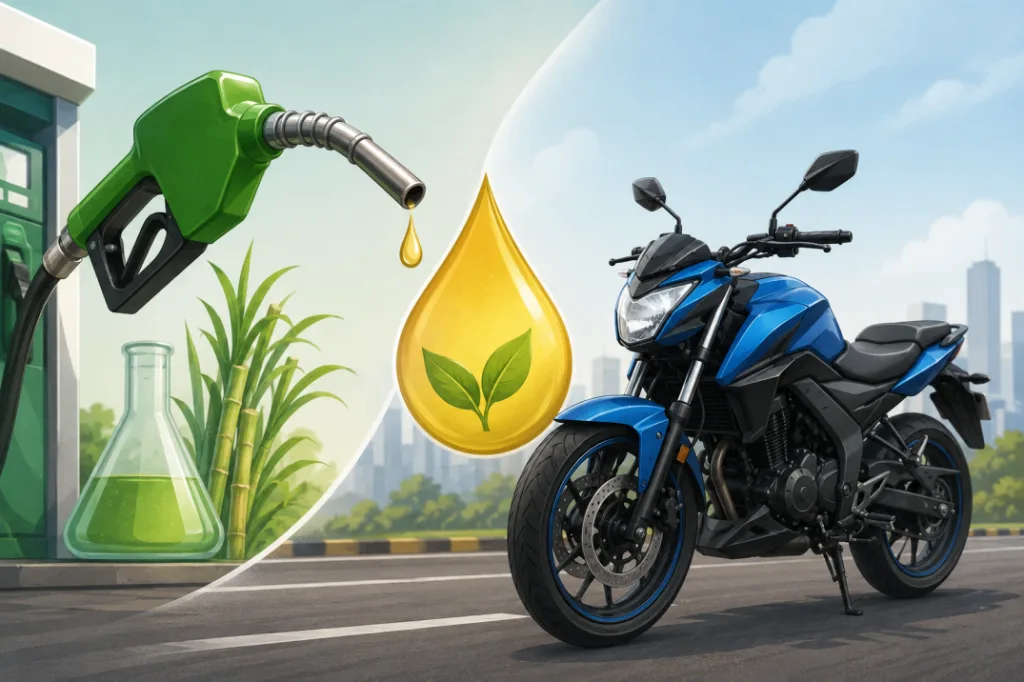
The minister also said there is no proposal to provide lower-blend or non-blended petrol at select fuel stations, stating that maintaining separate supply chains would increase operational costs and dilute the benefits of the ethanol blending programme.
Why is the government backing E20 fuel?
Defending the E20 rollout, Gopi said India achieved its 20% ethanol blending target five years ahead of schedule, with average blending increasing from 1.53% in 2013-14 to 20% during the 2025-26 supply year.
According to the minister, the Ethanol Blended Petrol (EBP) Programme has delivered multiple benefits since 2014-15, including:
Saving over ₹1.97 lakh crore in foreign exchange.
Reducing crude oil imports by nearly 316 lakh tonnes.
Preventing around 952 lakh tonnes of carbon dioxide emissions.
Generating more than ₹1.66 lakh crore in additional income for farmers.
Addressing concerns over vehicle performance, Gopi said the government has not received any widespread or substantiated complaints from vehicle manufacturers, industry bodies or consumers regarding engine failures, corrosion, fuel pump issues or water contamination linked to E20 fuel.
He added that more than 20 crore two-wheelers and over three crore petrol cars, including several manufactured before E20 certification, have been operating on higher ethanol-blended fuel without verified evidence of widespread engine damage.
The minister acknowledged that vehicles originally designed for E10 fuel may witness a 3-5% reduction in fuel efficiency while using E20. However, he said ethanol-blended fuel also offers higher octane levels and cleaner combustion, and manufacturers continue to honour warranties for vehicles using compliant E20 fuel.
Also Read | Sikkim tunnel landslide triggers gas leak, 8 dead, over 18 feared trapped
Regarding issues of food security, Gopi asserted that ethanol manufacturing employs only excess food grains after meeting the needs of the Public Distribution System, National Food Security Act and buffer stocks. Also, he stated that maize has become a significant input for ethanol production, making up 37% of ethanol output in 2025-26 against none in 2021-22.
The government reaffirmed that its long-term policy would be about cleaner and sustainable fuels through the National Policy on Biofuels and the Ethanol Blended Petrol Programme.
FAQs
Q1. Is E25 petrol being introduced in India by the government?
No. The Central Government has stated that there is no current plan to increase the ethanol content in petrol beyond the present 20% (E20).
Q2. Does E20 petrol harm vehicle engines?
As per the government, there is no proven case of damage or malfunction in engines due to E20 fuel, although some older E10 vehicles may see a slight reduction in efficiency by 3-5%.
