























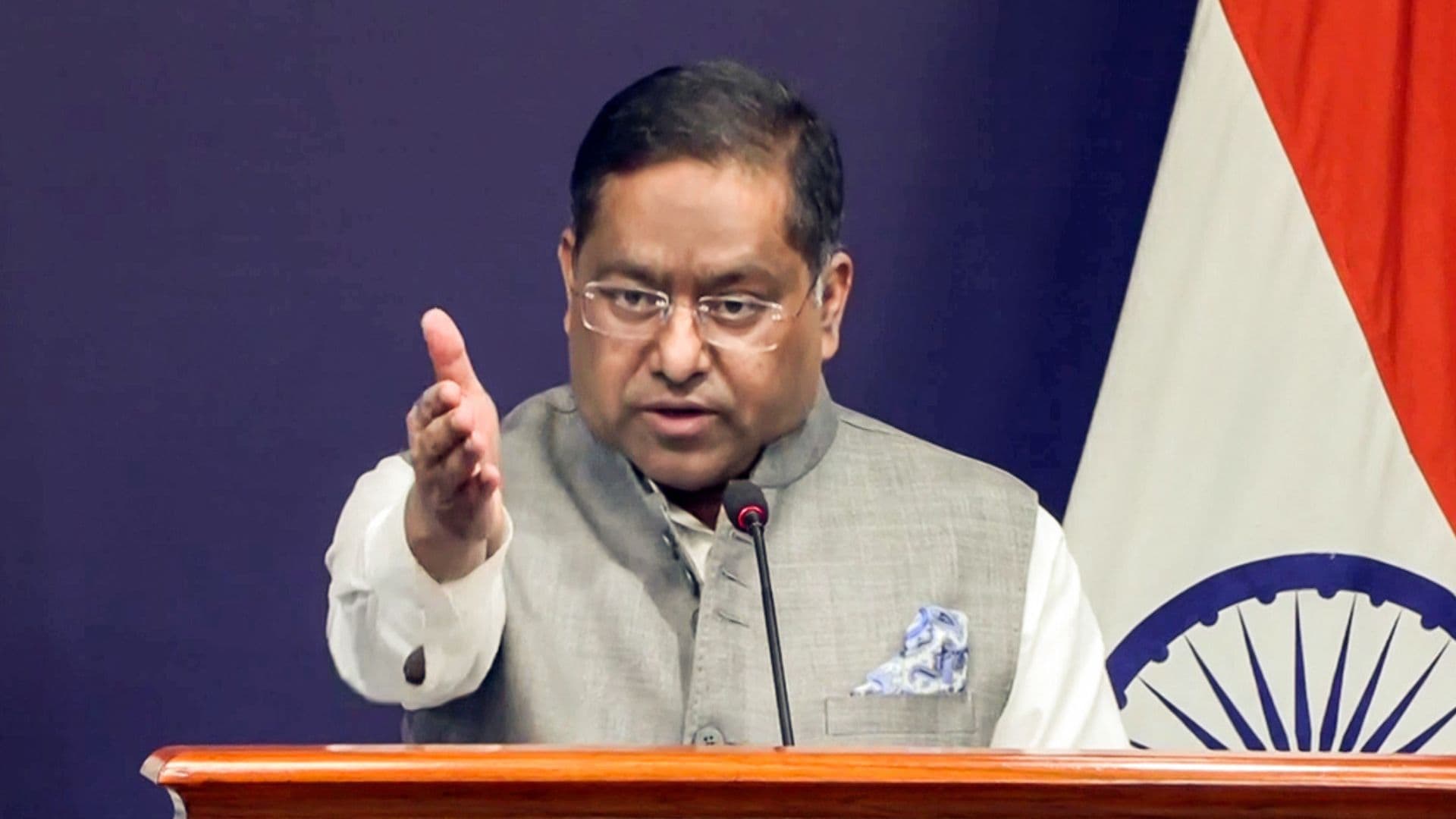
India has reaffirmed its position on the suspended Indus Waters Treaty after senior Pakistani leaders issued sharp remarks over the sharing of river waters. Responding on Friday, the Ministry of External Affairs (MEA) said New Delhi’s stand remains unchanged and linked the treaty’s current status to Pakistan’s continued support for cross-border terrorism.
MEA says India’s position remains unchanged
Addressing the media, MEA spokesperson Randhir Jaiswal said India continues to maintain the same position on the Indus Waters Treaty (IWT).
“India’s position on the Indus Water Treaty is consistent. The IWT stands in abeyance in response to Pakistan’s continued sponsorship of cross-border terrorism. Pakistan must credibly and irrevocably abjure its support for cross-border terrorism,” Jaiswal said.
#WATCH | Delhi: On the Indus Water Treaty (IWT), MEA Spokesperson Randhir Jaiswal says, "… India's position on the Indus Water Treaty is consistent. The IWT stands in abeyance in response to Pakistan's continued sponsorship of cross-border terrorism. Pakistan must credibly and… pic.twitter.com/ah8dDqwFju
— ANI (@ANI) July 3, 2026
India had earlier placed the treaty in abeyance following the Pahalgam terror attack in April 2025.
Also Read | PM Modi New Zealand visit to focus on free trade agreement and stronger ties
Pakistan minister warns over Indus water issue
The MEA’s response came days after Pakistan’s climate change minister Musadik Malik issued a strong warning over the river water dispute.
According to Dawn, Malik alleged that India was trying to stop water from flowing into Pakistan.
“There is a tap being controlled by the prime minister of a neighbouring country. He says he will not let even a drop of water flow into Pakistan,” Malik said.
He also warned that Pakistan would “cut off those hands” that attempted to control the flow of Indus waters. Videos of his remarks were carried by several Pakistani media outlets and later circulated online.
Pakistan calls water a matter of regional peace
Earlier, Pakistan’s foreign minister Ishaq Dar also criticised India’s decision to suspend the treaty. Speaking on the issue, Dar said any move to deny Pakistan its share of water under the Indus Waters Treaty would amount to the “weaponization of water” and could affect peace and security in the region.
“Shared waters must never be weaponized. They should remain a bridge between nations, guided by cooperation, dialogue, and respect for international law for the benefit of present and future generations,” Dar was quoted as saying by AP.
He described water as vital for human dignity, food security, economic development and environmental sustainability.
Also Read | Govt launches probe into iPhone 18 Pro leak linked to Tata Electronics breach
Pakistan says treaty cannot be suspended unilaterally
Dar also maintained that Pakistan considers the Indus Waters Treaty to be legally valid despite India’s decision to keep it in abeyance.
“The suspension of the treaty was illegal,” he said, adding that Pakistan believes the agreement continues to remain in force.
“No party can unilaterally suspend or terminate obligations under a treaty that contains no such provision,” Dar said.
The latest exchange highlights the continuing differences between India and Pakistan over the future of the Indus Waters Treaty, with both countries maintaining their respective positions on the decades-old water-sharing agreement.
FAQs:
Why did India suspend the Indus Waters Treaty?
India says the treaty remains in abeyance due to Pakistan’s continued sponsorship of cross-border terrorism.
What did the MEA say about Pakistan’s warning on the Indus Waters Treaty?
The MEA said India’s position is unchanged and reiterated that the treaty remains in abeyance.
