





















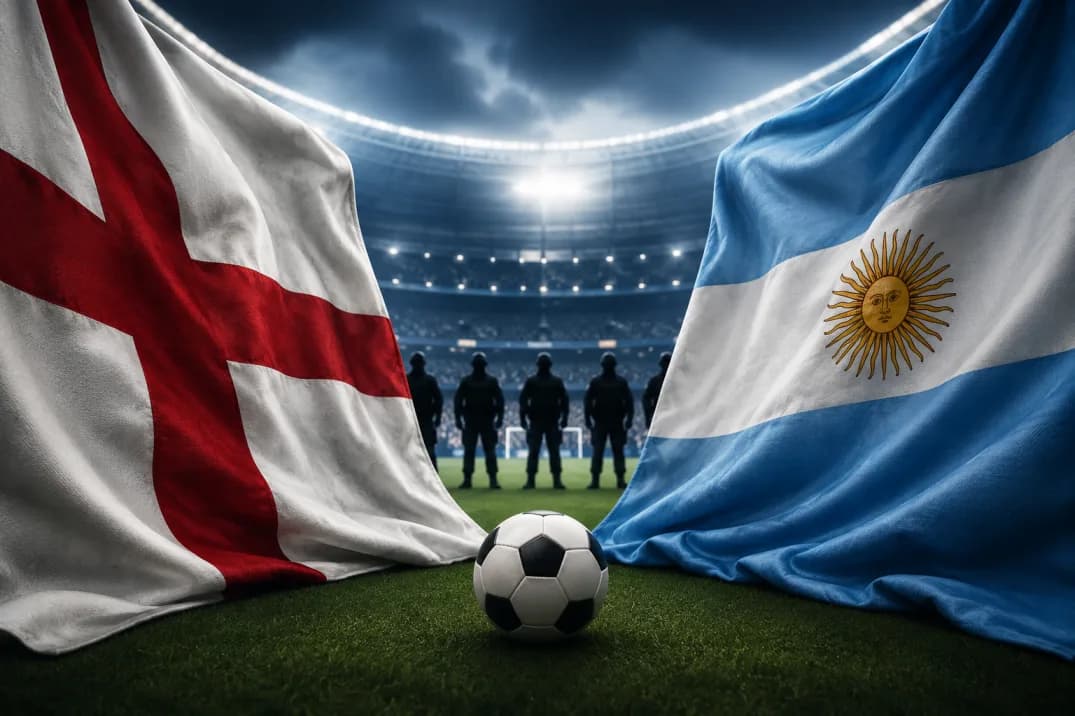
The FIFA World Cup semifinal between England and Argentina has been designated the tournament’s highest-risk fixture, with the FBI, FIFA, and local law enforcement putting in place enhanced security measures ahead of the match in Atlanta.
Officials from the FBI, FIFA, and the Atlanta Police Department met earlier this week to assess possible threats around the clash at Mercedes-Benz Stadium.
The concern is not based on a specific terror threat but on the possibility that emotions around one of football’s fiercest rivalries could spill over among supporters.
Also Read | Rodri masterclass vs France: How Spain’s midfield maestro controlled the World Cup 2026 semifinal
The FBI has rated England vs Argentina as the “highest risk” match of the World Cup. pic.twitter.com/HH95XH4qoy
— WorldCup Xtra (@TheFootballLad) July 15, 2026
A most watchful affair awaits
To reduce the chance of confrontations, England and Argentina fans will enter the stadium through separate gates. Organizers, however, have said there will be no segregation once fans are inside, largely because many tickets have been resold and the original seating pattern has shifted.
Atlanta police have also increased deployments around the stadium, team hotels, and entertainment districts.
In a statement carried by The Financial Express, the department said, “As Atlanta prepares to host an upcoming FIFA World Cup semifinal match… additional personnel and resources are already deployed to help ensure a safe and enjoyable experience for everyone.”
The England vs Argentina World Cup semifinal has reportedly been classified as the tournament’s highest-risk match by the FBI. Atlanta will set up separate entry routes for both fan groups, though there will be no physical segregation inside the stadium. pic.twitter.com/xm1NBg4uG6
— Shanghai Daily (@shanghaidaily) July 14, 2026
Old grudges cast long shadows
The security response reflects how much more than football hangs over this fixture.
England and Argentina’s rivalry is shaped by decades of political tension and historic flashpoints, most notably the 1982 Falklands War, which claimed 907 lives after Argentina invaded the islands before Britain regained control.
That background resurfaced again this week when Argentina’s foreign minister reiterated the country’s claim over the Falkland Islands, a position swiftly rejected by the British government led by Prime Minister Sir Keir Starmer.
Argentina’s players have also repeatedly celebrated victories by singing songs referencing the islands, known in Argentina as Las Malvinas.
pic.twitter.com/LMjr08IgRO
— Pitch Wire (@wire_pitch) July 14, 2026
🚨🇺🇸 BREAKING: FBI classifies England vs Argentina as the highest-risk match of the World Cup. ⚠️
According to The Mirror, the FBI has identified the England vs Argentina World Cup semi-final as the highest-risk fixture of the tournament from a security…
Let football do the talking
Argentina coach Lionel Scaloni has tried to keep the focus on football.
“The message to the Argentine people is that this is a soccer match. We’re going to face a great team with a great coach, but it is just a soccer match, nothing more than that,” he said.
His remarks echoed FIFA’s long-standing position that politics should remain separate from the game, even as the rivalry continues to carry political weight beyond the pitch.
Why does this rivalry still captivate the football world?
The rivalry has produced some of the World Cup’s most famous and controversial moments.
The 1986 quarter-final in Mexico City remains the most iconic, when Diego Maradona scored with what became known as the “Hand of God” before adding his solo “Goal of the Century” minutes later.
The hostility predates the Falklands War. During the 1966 quarter-final at Wembley, Argentina captain Antonio Rattín was sent off amid a fiery encounter, and England manager Alf Ramsey later referred to Argentina’s players as “animals.”
Another tense chapter came at France 1998, when David Beckham’s red card against Diego Simeone contributed to England’s penalty-shootout defeat.
With that history in the background, authorities in Atlanta are treating Wednesday’s semi-final as a major crowd-security operation as well as a football match.
Also Read | FIFA set to break tradition with 30-minute World Cup halftime show
FAQs
Q1: Why has the FBI labelled England vs Argentina the highest-risk World Cup match?
The match has been classified as high risk because of the intense historic rivalry between the two nations and the potential for crowd-related security issues.
Q2: What security measures are in place for the England vs Argentina World Cup semi-final?
Authorities have increased police deployment and arranged separate stadium entry points for England and Argentina supporters.
