



















The Supreme Court on Tuesday said allegations of police excesses and violence against police personnel during the CJP protests raised a prima facie case for an independent inquiry and that the matter could not be resolved without a fair, evidence-based probe.
A bench led by Chief Justice of India (CJI) Surya Kant, along with justices Joymalya Bagchi and V Mohana, said the competing versions needed scrutiny and that the court was considering whether to set up an independent committee or a special investigation team.
It also granted interim protection to protesting students who are eligible for relief and directed the immediate release of all detained minors without criminal antecedents.
Operating Part of the Supreme Court Order in CJP case
— Navroop Singh (@TheNavroopSingh) July 28, 2026
A) CCTV Footage, Drone, Body cam, wirless, PCT logs preserved.
B) No personal data of protestors shall be disclosed or made public and be preserved
C) May not publish details of Students in Protests
D) NCT of Delhi &… pic.twitter.com/q2yzdpXzad
Also Read | 5 Indians held in Thailand over ₹70 lakh kidnapping plot
Where the scales begin to tip
The order came on a batch of petitions that challenged the police response to the July 20 march to Parliament in Delhi and the wider agitation that followed in several states.
According to the petitioners, the violence and the use of force during the protests demanded judicial scrutiny, while the court said allegations from both sides needed to be examined.
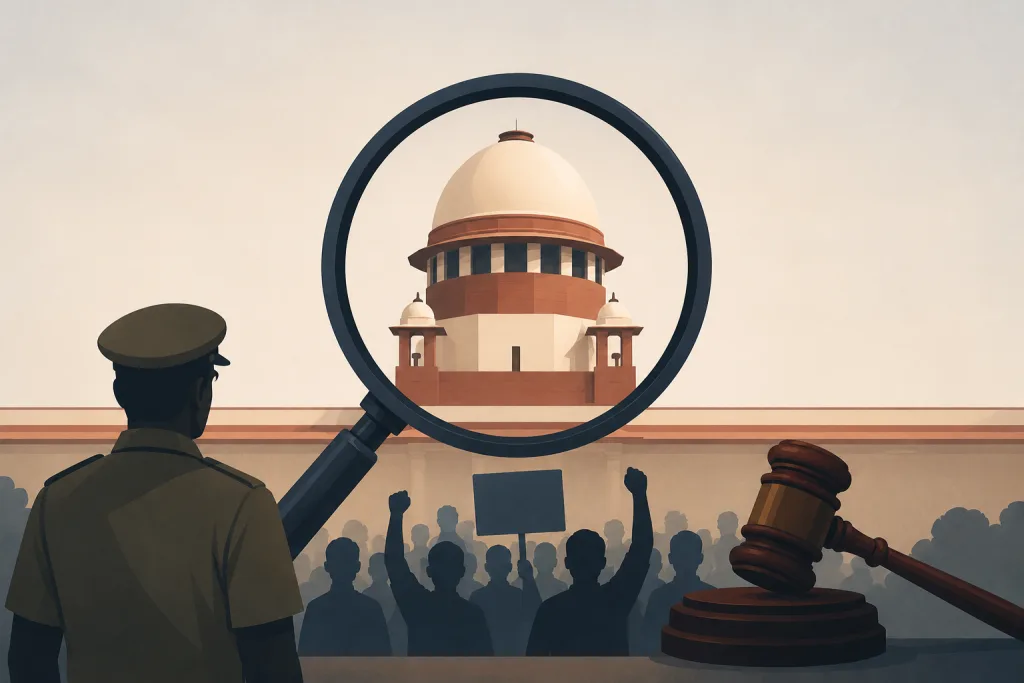
“The allegations by petitioners make out a prima facie case for an independent probe,” the court recorded, adding that such an exercise would also have to address the concerns raised by the families of injured police personnel and the Centre’s submissions.
The bench issued notices to the union government and the chief secretaries of Delhi, Maharashtra, Bihar, Assam, Kerala, West Bengal, Madhya Pradesh, and Uttar Pradesh.
Every frame may yet tell its tale
The court also ordered states where the protests were held to preserve CCTV footage, drone recordings, body-camera footage, wireless communication records, PCR logs, and other digital evidence linked to the demonstrations.
It further said any digital data collected on protesters should be preserved but not made public.
At the same time, the bench restrained authorities from taking coercive action against protesting students who are eligible for protection, while clarifying that the relief would not apply to people with criminal antecedents.
The Delhi government was allowed to continue investigating FIRs already registered, but the court said no coercive action should be taken against protected students while the proceedings remain pending.
#WATCH | Delhi | Cockroach Janta Party Chief Spokesperson Saurav Das says, "The government gave us a guarantee that all FIRs filed against students and protesters so far would be withdrawn and that no action would be taken against any protester in the future, not just in Delhi,… pic.twitter.com/CVGFBkDXQu
— ANI (@ANI) July 28, 2026
Will this rewrite the rules of protest policing?
During the hearing, the Centre said it had no objection to an independent probe, though it disputed the allegations of excessive force and said the government would act in whatever manner the court considered appropriate.
Solicitor General Tushar Mehta told the court that “miscreants” had infiltrated the protests, while the bench noted that even peaceful demonstrations can be infiltrated by unruly elements and turn violent.
The court said it was also looking at whether a broader, all-India protocol on protests and crowd control was needed and signaled that existing legal principles on police response to demonstrations may require updating.
Also Read | Mumbai man warns of hidden UPI AutoPay subscription charges
FAQs
Q1: Why is the Supreme Court considering an independent probe into the CJP protest violence?
The Supreme Court said the allegations of police excesses and attacks during the protests warrant a fair and independent investigation.
Q2: What relief did the Supreme Court grant to student protesters?
The court ordered the release of detained minors without criminal antecedents and protected eligible student protesters from coercive action while the case is pending.
